
MENU

MENU

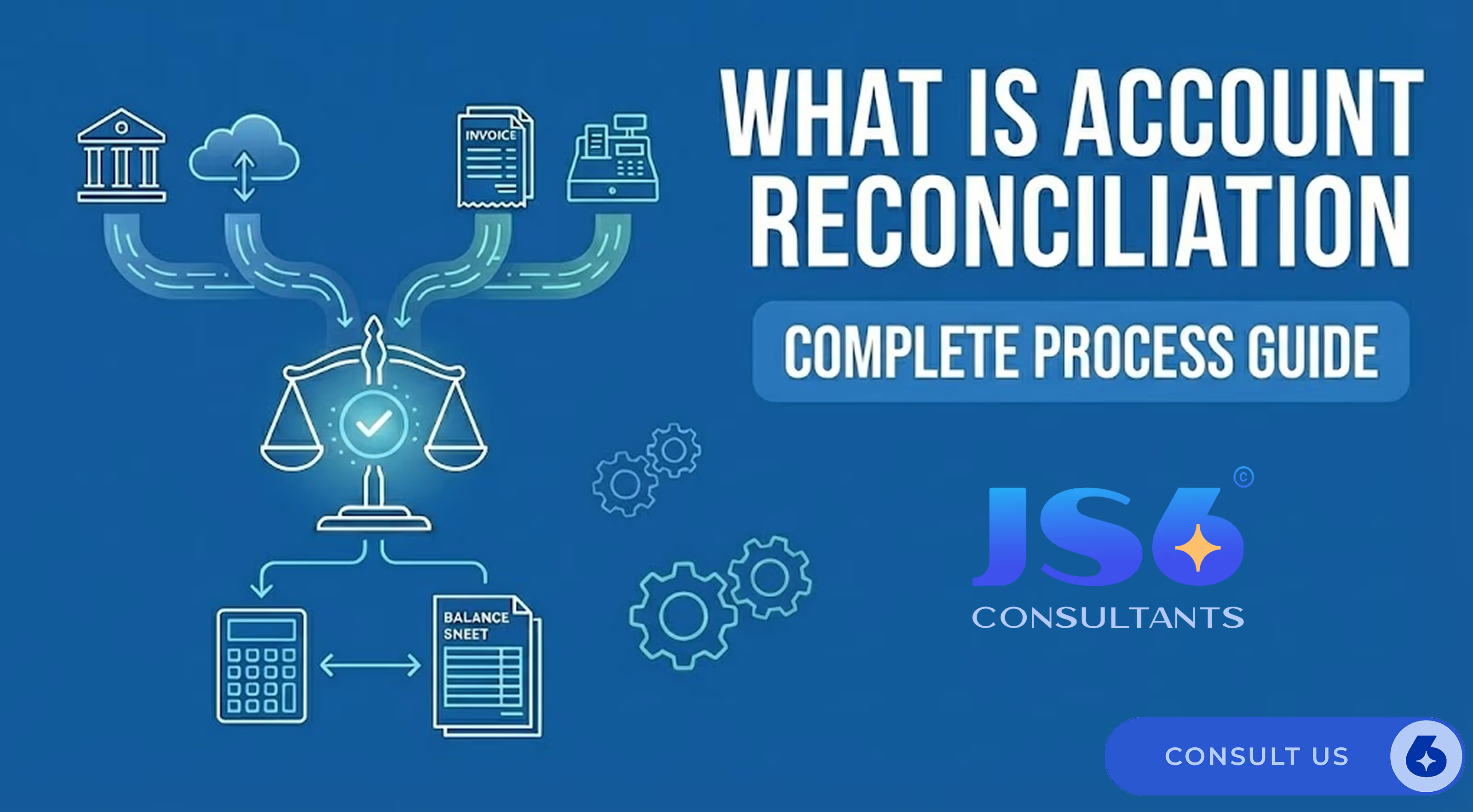
Every business owner knows the sinking feeling that comes with discovering financial discrepancies. A payment that wasn't recorded, an invoice that disappeared into thin air, or bank statements that don't match internal records—these issues don't just create confusion. They can lead to serious financial consequences, compliance problems, and damaged business relationships.
Understanding what is account reconciliation: definition and how it works isn't just about keeping clean books. It's about building a foundation of financial accuracy that supports every business decision you'll make. Whether you're managing a growing startup or running an established enterprise, reconciliation protects your business from costly errors while providing the clarity needed for strategic planning.
At JS6 Consultants, we've seen firsthand how proper reconciliation transforms business operations. Companies that implement systematic reconciliation processes experience fewer financial surprises, stronger audit outcomes, and improved cash flow management. The question isn't whether you should reconcile your accounts—it's how effectively you're doing it right now.
Account reconciliation is the systematic process of comparing two sets of financial records to ensure they match and accurately reflect business transactions. Think of it as a financial health check that verifies every dollar coming in and going out of your business is properly documented across all your financial systems.
The purpose extends far beyond simply making numbers match. Reconciliation serves as your first line of defense against fraud, catches honest mistakes before they compound, and ensures your financial statements accurately represent your business position. When you reconcile accounts regularly, you're essentially creating a verified audit trail that stands up to scrutiny from tax authorities, investors, and stakeholders.
Businesses and individuals perform account reconciliation for several critical reasons. First, it provides confidence in financial data when making business decisions. Second, it identifies discrepancies early when they're easiest to resolve. Third, it maintains compliance with accounting standards and regulatory requirements. Finally, it protects against both internal and external fraud by highlighting unusual or unauthorized transactions.
Bank reconciliation compares your business's internal cash records with statements provided by your financial institution. This process catches timing differences, such as outstanding checks or deposits in transit, along with bank fees, interest payments, and potential errors. Most businesses perform bank reconciliation monthly, though high-volume operations might reconcile weekly or even daily.
This type matches purchase orders, invoices, and payment records with vendor statements. Vendor reconciliation prevents duplicate payments, catches pricing discrepancies, and maintains strong supplier relationships by ensuring timely, accurate payments. It's particularly important for businesses with multiple vendors or complex supply chains.
Similar to bank reconciliation, this process verifies corporate credit card statements against internal expense records. It ensures employees are following spending policies, catches unauthorized charges, and maintains detailed records for tax deductions. Credit card reconciliation has become increasingly important as more businesses adopt card-based expense management.
This broader reconciliation verifies all balance sheet accounts, including assets, liabilities, and equity. It's typically performed monthly or quarterly and ensures your financial position is accurately stated. Balance sheet reconciliation catches errors in account classification, valuation issues, and discrepancies between subsidiary ledgers and general ledger control accounts.
Financial statements serve as the primary communication tool between your business and stakeholders. Investors, lenders, and partners base critical decisions on these documents. Reconciliation ensures every number on your balance sheet, income statement, and cash flow statement reflects reality rather than errors or omissions.
Without regular reconciliation, small mistakes accumulate into significant misstatements. A missed invoice here, an uncategorized payment there—over time, these errors create a distorted picture of your financial health. This distortion can lead to poor business decisions, from expanding when you should conserve cash to missing growth opportunities because your data suggests you can't afford them.
When auditors review your financial records, they're looking for evidence that your accounting processes are reliable. Regular reconciliation creates the documentation trail auditors need to verify your financial statements. Companies with strong reconciliation practices breeze through audits, while those with spotty records face lengthy, expensive audit processes filled with follow-up questions.
Audit readiness isn't just about external audits either. Internal audits, tax examinations, and due diligence reviews all become smoother when you maintain reconciled accounts. The time and money saved during these processes often exceeds the investment in proper reconciliation procedures.
Cash flow problems sink more businesses than profitability issues. You can't manage what you can't measure accurately. Reconciliation provides the real-time visibility into cash positions that effective cash flow management requires. When you know exactly what funds are available, you make better decisions about when to pay vendors, when to make investments, and how to handle seasonal fluctuations.
Reconciliation also identifies cash flow issues before they become crises. Discovering that customer payments are taking longer than expected gives you time to adjust collection procedures or arrange for short-term financing. Finding out during a cash crunch leaves you scrambling with limited options.
Accounting standards like GAAP and IFRS require accurate, verifiable financial records. Regulatory bodies expect businesses to maintain reconciled accounts as part of their compliance obligations. Failure to reconcile properly can result in penalties, legal issues, and damage to your business reputation.
For publicly traded companies, the stakes are even higher. Regulations require specific internal controls over financial reporting, and reconciliation is a fundamental component of these controls. Even private companies benefit from compliance-ready reconciliation processes, especially if they're seeking investment or planning to go public.
Understanding what is account reconciliation: definition and how it works requires breaking down the process into manageable steps. While specific reconciliation procedures vary depending on the account type, the general process follows a consistent pattern.
Begin by gathering all relevant documents. For bank reconciliation, you'll need bank statements, deposit receipts, check registers, and electronic payment confirmations. For vendor reconciliation, collect purchase orders, receiving reports, invoices, and payment records. The key is having both your internal records and external statements for the period you're reconciling.
Organization matters here. Create a systematic filing approach that makes documents easy to locate. Many businesses scan and store reconciliation documents digitally, creating searchable archives that simplify future audits and reviews.
Place your internal records side-by-side with external statements and begin the comparison process. Look for matching transactions first—these require no further action beyond noting that they're reconciled. Modern accounting software can automate much of this matching process, but human review remains important for catching nuances software might miss.
Pay attention to timing differences. A payment you recorded on the last day of the month might not appear on your bank statement until the following month. These legitimate timing differences need to be tracked separately from true discrepancies.
When numbers don't match, resist the urge to simply adjust one side to match the other. Instead, investigate why the discrepancy exists. Common causes include data entry errors, duplicate transactions, missing transactions, bank fees, unauthorized charges, or fraudulent activity.
Create a systematic approach to investigation. Check for transposed numbers, review source documents, contact banks or vendors for clarification, and interview employees who processed the transactions. Document your investigation process—this creates an audit trail and helps prevent similar issues in the future.
Once you've identified the cause of discrepancies, make appropriate adjustments to your records. This might involve recording bank fees that weren't in your system, reversing duplicate entries, or adding missing transactions. Each adjustment should include supporting documentation explaining why it was made.
Some discrepancies might require contacting external parties. If your bank charged fees you don't recognize, contact them for explanation or reversal. If a vendor's statement shows unpaid invoices you've already paid, provide proof of payment and request statement correction.
After all discrepancies are resolved and adjustments are made, prepare a reconciliation report. This document should clearly show the starting balance from each source, list all reconciling items, and arrive at a final reconciled balance that both sources agree on.
Store these reports systematically. They serve as evidence of your reconciliation process during audits and provide historical reference when investigating future discrepancies. Many businesses maintain reconciliation reports for at least seven years to comply with record retention requirements.
As businesses grow, transaction volumes increase and become more complex. Multi-currency transactions, inter-company transfers, and sophisticated payment arrangements make reconciliation time-consuming. Each additional layer of complexity creates more opportunities for discrepancies and requires more time to resolve.
Large transaction volumes also make it difficult to investigate every discrepancy thoroughly. Businesses often find themselves choosing between perfect reconciliation and timely reconciliation. This compromise can lead to accumulated unresolved items that become harder to address over time.
Human error remains one of the most common causes of reconciliation issues. Transposed numbers during data entry, missed transactions, incorrect account coding, and calculation mistakes all create discrepancies that must be found and corrected. The more manual your reconciliation process, the higher the error rate.
Fatigue contributes significantly to manual errors. Reconciliation is detail-oriented work that requires sustained concentration. After hours of comparing numbers, even experienced professionals make mistakes. These errors then require additional time to identify and correct, compounding the workload.
Incomplete financial records make reconciliation difficult or impossible. Missing invoices, lost receipts, inadequate transaction documentation, and gaps in bank statements all create reconciliation roadblocks. Sometimes the missing data exists somewhere in your organization but isn't easily accessible. Other times, it's genuinely lost and must be reconstructed from other sources.
The challenge intensifies when reconciling older periods. The longer you wait to reconcile, the harder it becomes to locate source documents and remember transaction details. Employees move on, memories fade, and documentation gets misfiled or destroyed.
Different departments often manage different financial accounts. Sales handles customer payments, purchasing manages vendor relationships, finance processes payroll, and operations handles petty cash. When these departments don't communicate effectively, reconciliation suffers.
Information silos prevent reconciliation teams from accessing the data they need. The sales team might know why a particular customer payment is delayed, but if that information doesn't reach accounting, it appears as an unexplained discrepancy. Breaking down these silos requires organizational commitment and systematic communication protocols.
Frequency matters more than most businesses realize. Monthly reconciliation has become the standard, but high-volume accounts benefit from weekly or even daily reconciliation. The sooner you identify discrepancies, the easier they are to resolve. Fresh memories and readily available documentation make investigation much faster.
Consistency is equally important. Reconciling sporadically creates gaps that compound problems. Establish a reconciliation schedule and stick to it. Make reconciliation a non-negotiable part of your monthly close process rather than something that happens when time permits.
Technology has transformed reconciliation from a tedious manual process into a streamlined operation. Accounting software can automatically import bank statements, match transactions based on rules you define, and flag discrepancies for review. This automation reduces errors while freeing your staff to focus on investigation and resolution rather than data entry.
However, automation isn't a complete solution. Software can't interpret every nuance or understand business context the way humans can. The best approach combines automated matching with human oversight. Let technology handle routine matching while your team focuses on exceptions and complex situations.
Every reconciliation should create a paper trail that others can follow. Document your reconciliation process, note all adjustments, maintain supporting evidence, and retain records according to your retention policy. This documentation serves multiple purposes—it satisfies auditors, helps train new staff, and provides reference when similar issues arise.
Clear documentation also includes maintaining an audit trail within your accounting system. Track who made changes, when they were made, and why. This accountability discourages errors and fraud while making it easier to trace problems back to their source.
Implement a review process where someone other than the person who prepared the reconciliation reviews it before finalization. This second set of eyes catches errors that the original preparer missed. The reviewer should verify that all discrepancies were properly investigated, adjustments are supported by documentation, and the reconciliation logic is sound.
Cross-checking works best when the reviewer understands both the reconciliation process and the business transactions being reconciled. Generic reviews that simply verify mathematical accuracy miss contextual issues that someone familiar with your operations would catch.
Don't let discrepancies linger. Address them promptly while information is fresh and people are available to answer questions. Unresolved reconciliation items accumulate quickly, creating a backlog that feels overwhelming and often gets ignored.
Create escalation procedures for reconciliation items that can't be resolved within a reasonable timeframe. Sometimes you'll need management intervention to get information from other departments or authorization to write off immaterial differences. Having clear escalation paths prevents reconciliation from getting stuck.
Transparent finances build trust with investors, lenders, and partners. When stakeholders can see that your financial records are accurate and reliable, they're more willing to support your growth initiatives. Reconciled accounts demonstrate that you have proper financial controls in place and take stewardship seriously.
Internal transparency matters too. Management makes better decisions when they trust their financial data. Reconciliation removes doubt from the decision-making process, allowing leaders to act decisively based on accurate information rather than hedging because they're unsure if the numbers are right.
Growth requires investment, and investment requires confidence in financial projections. Reconciled historical data provides the foundation for accurate forecasting. When you know your cash flows, profit margins, and expense patterns with certainty, you can project future performance with greater accuracy.
Strategic decisions become clearer when based on reconciled data. Should you expand into a new market? Can you afford additional staff? Is it time to invest in new equipment? These questions demand accurate financial information. Making major decisions based on unreconciled accounts is like navigating without a map—you might reach your destination, but you'll take a lot of wrong turns along the way.
Preventing errors saves money—lots of it. Duplicate payments, missed vendor discounts, bank fee overcharges, and undetected fraud all drain profits. Regular reconciliation catches these issues before they become expensive problems. The cost of maintaining proper reconciliation processes is almost always less than the losses prevented.
Beyond preventing losses, reconciliation often identifies savings opportunities. You might discover services you're paying for but not using, vendors charging more than agreed, or expense categories where spending has crept higher than expected. These insights enable targeted cost-control measures that improve your bottom line.
Account reconciliation isn't just a compliance requirement—it's a strategic tool that drives better business outcomes. Organizations that embrace reconciliation as a core financial practice enjoy greater accuracy, stronger audit results, improved cash flow management, and enhanced decision-making capabilities.
The challenge lies in maintaining consistent, high-quality reconciliation processes alongside all your other business priorities. Many companies find they lack the time, expertise, or resources to reconcile as frequently and thoroughly as they should. That's when professional support makes sense.
JS6 Consultants specializes in turning reconciliation from a burden into a business advantage. Our tech-driven approach combines efficiency with accuracy, delivering reconciliation services that keep pace with your business while maintaining the attention to detail that effective reconciliation requires. We've helped organizations across industries achieve 96% success in AR collections by ensuring their financial foundations are solid.
Whether you're struggling with a reconciliation backlog, looking to improve your current processes, or simply want to free your team from time-consuming reconciliation tasks, JS6 Consultants offers solutions tailored to your needs. With 50+ projects completed and operations spanning multiple countries, we bring the experience and infrastructure needed to handle reconciliation at any scale.
Ready to transform your reconciliation process? Let JS6 Consultants help you achieve balance—not just in your books, but in how you allocate your most valuable resource: time. When you partner with us, you're not just outsourcing a task. You're gaining a team committed to your financial accuracy and business success.
What happens if I don't reconcile my accounts regularly?
Unreconciled accounts accumulate errors over time, making them progressively harder to correct. You risk missing fraudulent transactions, making business decisions based on inaccurate data, and facing complications during audits or tax reviews. The longer accounts remain unreconciled, the more time-consuming and expensive the eventual reconciliation becomes.
How often should small businesses reconcile their accounts?
Small businesses should reconcile bank accounts monthly at minimum. High-volume accounts or those critical to business operations might warrant weekly reconciliation. Credit card accounts should be reconciled monthly, while balance sheet accounts can often be reconciled quarterly, though monthly is preferred for companies with significant transaction volumes.
Can account reconciliation be fully automated?
While automation significantly streamlines reconciliation by matching transactions and flagging discrepancies, complete automation isn't advisable. Complex transactions, unusual items, and discrepancies requiring investigation still need human judgment. The best approach combines automated matching with skilled human oversight for exceptions and complex situations.
What qualifications should someone performing reconciliation have?
Reconciliation staff should understand basic accounting principles, possess strong attention to detail, demonstrate analytical skills for investigating discrepancies, and maintain familiarity with relevant accounting software. For complex reconciliations, professional accounting credentials like CPA or CMA provide valuable expertise.
How long does the reconciliation process typically take?
Timeline depends on transaction volume, account complexity, and reconciliation frequency. A simple bank account with moderate transaction volume might take 1-2 hours monthly. Complex accounts or those with significant discrepancies can take several days. Regular reconciliation reduces the time required as discrepancies are caught early.
What should I do if I discover fraud during reconciliation?
Document the suspected fraud immediately without alerting potential perpetrators. Notify management and, if appropriate, legal counsel. Preserve all evidence related to the fraudulent transactions. Consider bringing in forensic accounting specialists to investigate the full extent of the fraud. Review and strengthen internal controls to prevent recurrence.
Are there industry-specific reconciliation requirements?
Yes, certain industries face additional reconciliation requirements. Financial institutions must reconcile customer accounts, healthcare providers must reconcile patient billing and insurance payments, and publicly traded companies face specific regulatory requirements under SOX. Understanding your industry's specific requirements is essential for compliance.
How does JS6 Consultants ensure reconciliation accuracy?
JS6 Consultants employs a systematic approach combining technology and expertise. We analyze current processes to identify gaps, reconcile accounts transaction by transaction using specialized software, implement review procedures to catch errors, and maintain detailed documentation of all reconciliation work. Our 100 years of collective experience ensures we catch issues that less experienced teams might miss


