MENU

MENU

Growth changes everything about a business, including the technology demands that come with it. A company that once managed with a single IT generalist suddenly finds itself juggling new software platforms, remote employees, compliance requirements, and a growing list of devices that all need protection. Most business owners budget for the obvious expenses, yet the real financial picture rarely stops there.
That's where the conversation around In-House vs. Outsourced IT Support: The Hidden Costs for Growing Businesses becomes so important. On the surface, building an internal IT department looks like the safer, more controlled choice. Look closer, though, and the costs multiply in ways that rarely show up on a budget spreadsheet until it's too late. This article walks through the visible and hidden expenses tied to each approach, so you can make a decision grounded in the full financial reality rather than assumptions.
Every IT decision comes with a sticker price and a shadow price. The sticker price is easy to plan for. The shadow price is what quietly erodes margins over time.
Most leadership teams account for the predictable line items:
These costs are straightforward, and they're usually the numbers that show up in a first-year budget forecast.
The expenses that catch businesses off guard tend to hide behind everyday operations rather than appear as a single invoice. Employee turnover, extended training periods, unplanned downtime, and the inability to scale quickly all chip away at profitability. None of these show up as a distinct budget category, yet together they often outweigh the visible costs by a wide margin.
Building an internal department feels like the traditional route, and for some organizations, it still makes sense. Still, the full cost of ownership goes well beyond a paycheck.
Qualified IT professionals command competitive salaries, and that number climbs further once benefits, payroll taxes, and recruitment fees enter the equation. Filling a single specialized role can take months, and every open seat represents lost productivity elsewhere in the business.
Technology doesn't sit still, so neither can your IT staff. Certifications, ongoing education, and vendor-specific training all require both money and time away from daily responsibilities. Skipping this investment isn't really an option either, since outdated skills leave the business exposed to newer threats and inefficient systems.
When an IT employee leaves, they don't just take their job title with them. They take institutional knowledge about your systems, passwords, workarounds, and quirks that never made it into formal documentation. Replacing that person means starting the learning curve over again, often while critical systems sit unmonitored.
A single IT hire, or even a small internal team, can't realistically cover nights, weekends, holidays, and sick leave without gaps. Problems don't wait for business hours, and a server issue at 2 a.m. won't pause until someone clocks back in.
No individual can master every corner of modern IT. Cybersecurity, cloud infrastructure, networking, compliance, and software support each require distinct expertise. An in-house hire, however skilled, will inevitably have blind spots that specialized threats can exploit.
Outsourcing shifts the cost structure entirely, trading unpredictable internal expenses for a more transparent, scalable model.
Managed IT services typically operate on a monthly retainer, which makes budgeting far more predictable. Instead of guessing what a hiring cycle, training investment, or emergency repair might cost, businesses know their IT expense in advance.
A managed services provider brings an entire bench of specialists rather than a single point of failure. Around-the-clock monitoring also closes the coverage gaps that plague in-house teams, since threats and outages don't follow a nine-to-five schedule.
Outsourcing isn't without its own considerations. An external provider may take slightly longer to develop the same day-to-day familiarity with your team that an in-house employee builds naturally. Businesses also need to choose a provider carefully, since the relationship depends on clear communication and reliable service-level agreements.
Regardless of which model a business chooses, certain costs tend to surprise leadership teams that haven't planned for them in advance.
Every minute of system downtime translates into lost revenue, missed deadlines, and frustrated employees. Businesses that lack rapid response capabilities, whether internal or outsourced, often underestimate how quickly these losses accumulate.
A single data breach can cost far more than the IT budget that might have prevented it. Add regulatory fines, legal fees, and reputational damage, and the true price of inadequate security coverage becomes clear.
Growing businesses often hit a wall when their IT support can't keep pace with new hires, new locations, or new software needs. In-house teams face hiring lag, while poorly structured outsourcing contracts can create their own bottlenecks if flexibility wasn't built in from the start.
When IT problems land on the desk of a business owner or executive, that's time pulled away from strategy, sales, and growth initiatives. This opportunity cost rarely appears on a balance sheet, yet it's one of the most expensive hidden costs of all.
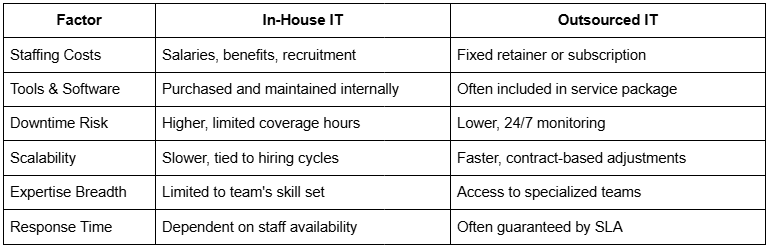
Viewed side by side, the trade-offs between In-House vs. Outsourced IT Support: The Hidden Costs for Growing Businesses become much easier to evaluate against your specific priorities.
There's no universal answer here, and the right structure depends heavily on your growth stage, budget, and risk tolerance.
Some businesses benefit from a blended approach, keeping a small internal presence for daily support while outsourcing specialized functions like cybersecurity or infrastructure management. This model captures the familiarity of in-house staff alongside the depth of external expertise.
JS6 Consultants works with growing businesses to design IT support structures that fit their actual needs rather than a one-size-fits-all package. Whether that means fully managed IT services, a hybrid support model, or scalable engagement that adjusts as the business expands, the goal stays the same: predictable costs, stronger security, and fewer surprises.
Businesses weighing In-House vs. Outsourced IT Support: The Hidden Costs for Growing Businesses don't have to make that decision alone. A conversation with JS6 Consultants can clarify which structure fits your current stage and where the hidden costs are most likely to appear.
Choosing between building an internal team and partnering with a managed provider isn't just a staffing decision, it's a financial strategy. The businesses that plan for hidden IT costs, not just the visible ones, tend to make far stronger decisions about where their technology dollars go. When it comes down to In-House vs. Outsourced IT Support: The Hidden Costs for Growing Businesses, the smartest path forward is the one that keeps your business supported without any costly surprises. Reach out to JS6 Consultants to find the structure that fits, before those hidden costs find you first.
Is outsourced IT support cheaper than in-house?
In most cases, yes, once hidden costs like turnover, training, and coverage gaps are factored in. Managed IT services costs tend to be more predictable than the full cost of an internal team.
Can outsourced IT support scale with my business?
Yes. Most managed service agreements are built to adjust as a business adds employees, locations, or new technology needs, which avoids the hiring lag that comes with in-house scaling.
What happens to institutional knowledge if I outsource?
A reputable provider documents systems, processes, and configurations thoroughly, which actually reduces the knowledge loss risk that comes with employee turnover in an internal team.
Can I combine in-house staff with outsourced support?
Absolutely. Many growing businesses use a hybrid model, keeping a small internal presence while outsourcing specialized or after-hours coverage to a managed IT provider.


.png)